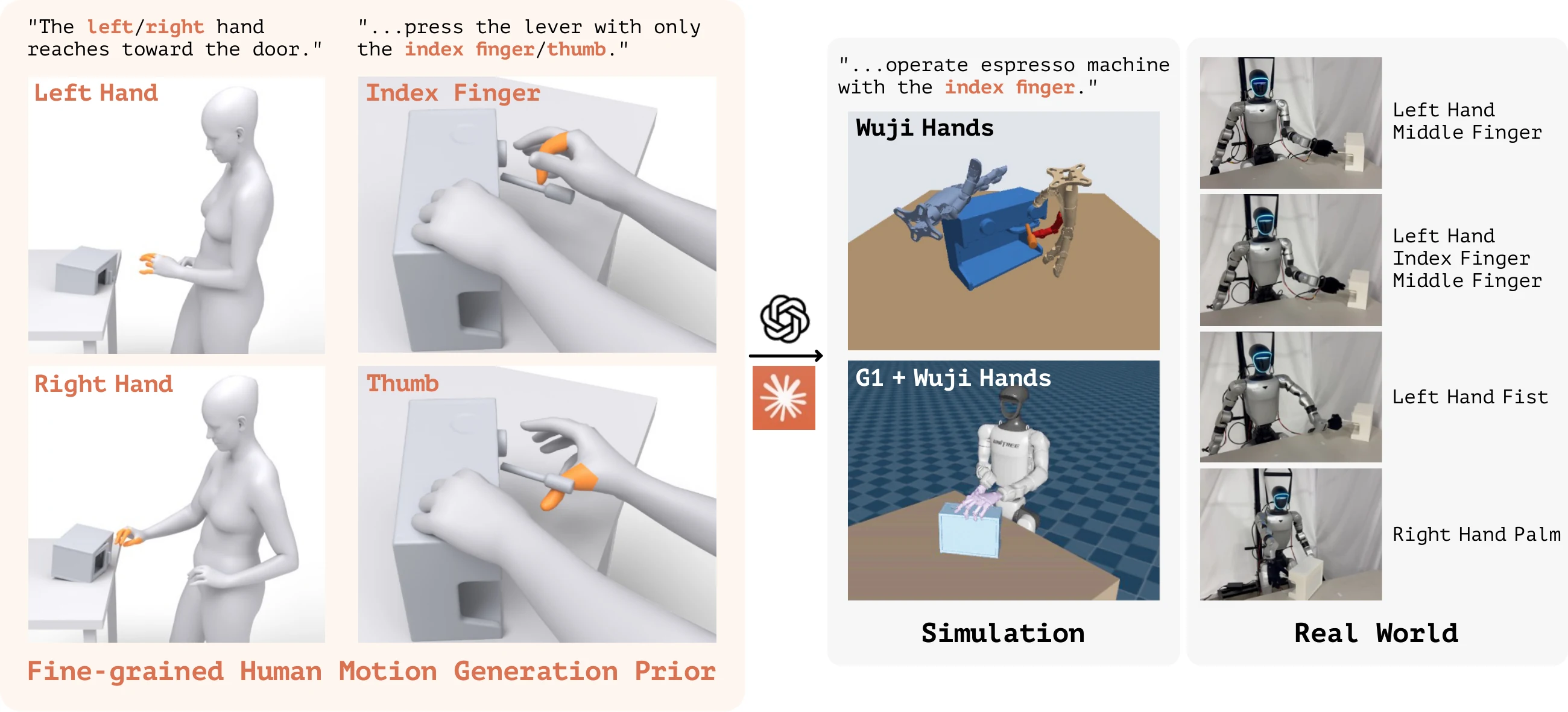
FineDex makes fine-grained intent both expressible and executable.
"The left/right hand reaches toward the door."
"…press the lever with only the index finger/thumb."
"…operate espresso machine with the index finger."
Abstract
Dexterity is, at its core, finger-level control, yet existing dexterous manipulation and human–object interaction (HOI) generation methods rarely let one specify how an interaction is performed: five-fingered hands are often reduced to grippers, or finger usage is copied from individual human demonstrations. We present FineDex, a framework that makes finger-level intent both expressible and executable. FineDex learns coordinated human body, hand, and object motions that follow fine-grained instructions on hand selection, individual fingers, and contacts with articulated objects. To bridge generation and execution, FineDex leverages generated interactions as actionable priors for an agent that discovers physically feasible contact strategies through practice in a physics-based digital twin. By adapting at test time without per-instance retraining, FineDex generalizes across fine-grained instructions and object configurations. Experiments demonstrate state-of-the-art HOI generation quality and fine-grained controllability, substantial improvements in dexterous manipulation success, and successful deployment on a real dexterous humanoid robot.
Swipe sideways to see the whole figure →
Fine-grained instruction-conditioned dexterous manipulation. FineDex generates human–object interaction priors that capture language-specified hand selection, finger-level contacts, and articulated-object interactions. These priors guide agentic dexterous manipulation in simulation and on real humanoid robots.
Method
Generate the intent, practice the execution
01
Generate
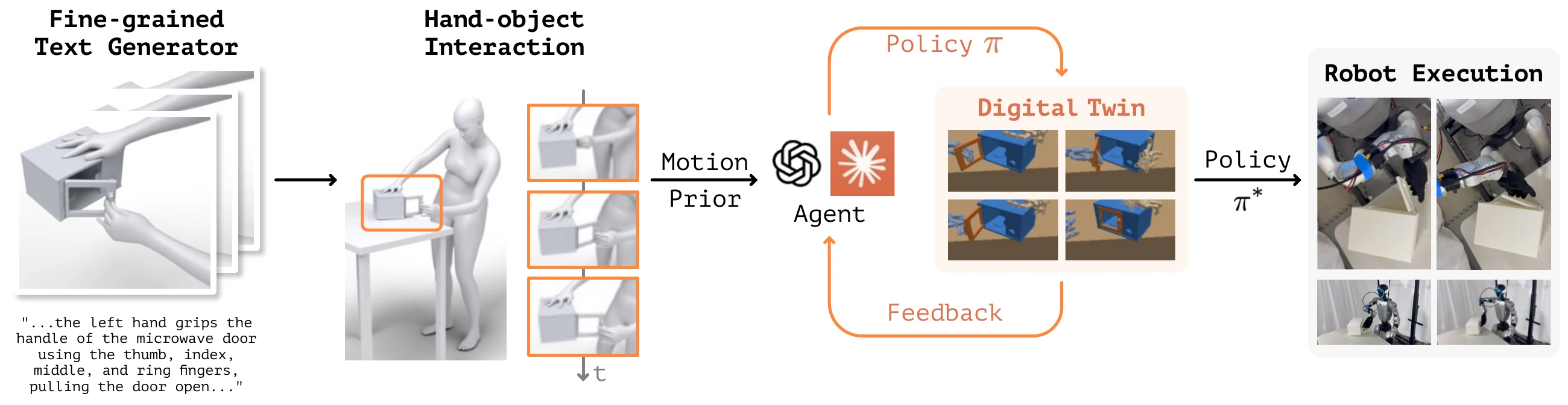
A diffusion generator turns fine-grained text, object geometry, and known frames into coordinated body, hand, and object motion.
02
Practice
An agent reads the generated interaction, proposes contact programs, and refines them with feedback.
03
Execute
Deployed on a Unitree G1 humanoid with Wuji 2.2 hands, adapting at test time without per-instance retraining.
Swipe sideways to see the whole figure →
Overview. The generated interaction x serves as a prior for an agent that proposes contact programs π and refines them through feedback in physics simulation. The most reliable program, π*, is executed on the robot.
Results
HOI generation
All baselines share the same split and first-frame conditioning; bimanual and whole-body metrics use retrained evaluators.
Method
Bimanual HOI
Whole-body HOI
Physical quality
FID ↓
R@3 ↑
MM-Dist ↓
Div →GT
Wrist (mm) ↓
FID ↓
R@3 ↑
MM-Dist ↓
AVE ↓
CR →GT
Pen (mm) ↓
FS (m/s) ↓
GT
0.00
0.788
3.38
10.72
0.0
0.00
0.720
3.79
0.0000
0.100
5.9
0.0022
EmbodyHOI†
5.13
0.576
5.24
9.64
77.9
2.32
0.629
4.59
0.0087
0.040
7.6
0.0064
Text2HOI
1.51
0.523
5.54
9.68
92.4
–
–
–
–
0.090
–
–
MAD-HOI†
5.63
0.583
5.45
9.77
104.8
–
–
–
–
0.082
–
–
HandMDM
25.59
0.308
8.35
9.10
161.3
–
–
–
–
0.022
–
–
HOIDiNi
8.22
0.477
6.30
8.80
151.6
23.65
0.311
8.14
0.0147
0.168
11.9
0.0462
HOI-FHLI
12.56
0.368
7.31
8.03
143.7
37.65
0.265
9.47
0.0188
0.079
4.6
0.0180
CoDA
8.85
0.507
5.98
9.17
141.4
71.20
0.244
10.72
0.0218
0.103
7.4
0.0433
FineDex
0.65
0.701
4.02
10.58
58.3
1.61
0.704
3.83
0.0075
0.092
7.8
0.0030
†: MAD-HOI is reimplemented and retrained; EmbodyHOI applies inference-time guidance to our backbone. –: unavailable for hand-only methods. Bold / underline: best / second best. →GT: closer to ground truth is better.
FingerBench
We propose a novel benchmark that evaluates whether generated motions follow hand- and finger-level instructions, and whether robots realize them in physics-based execution.
92.5%
Single-finger motion ↑
83.9%
Hand switch ↑
60.1%
Exclusive finger contact ↑
21.9%
Finger-conditioned robot success ↑
Method
Finger motion ↑
Finger contact ↑
Hand selection ↑
Robotic execution ↑
A1
A2
A3
A4
A5
B1
B2
B3
B4
Switch
Still
FC-SR
Robo-SR
GT
–
–
–
–
–
–
–
–
–
–
–
6.2
5.4
EmbodyHOI†
0.0
0.0
0.0
0.0
0.0
16.7
1.2
0.6
0.8
0.0
0.0
0.9
0.9
Text2HOI
0.0
0.0
0.0
0.0
0.0
15.5
0.8
0.4
0.5
1.1
0.0
9.4
6.2
MAD-HOI†
0.0
0.0
0.0
0.0
0.0
14.3
1.0
0.4
0.3
8.0
0.0
1.3
0.9
HandMDM
0.0
0.0
0.0
0.0
0.0
0.0
0.0
0.0
0.0
5.7
0.0
7.6
7.1
HOIDiNi
0.0
0.0
0.0
0.0
0.0
6.6
1.2
0.4
0.3
0.0
0.0
2.7
0.0
HOI-FHLI
0.0
0.0
0.0
0.0
0.0
7.9
1.2
0.8
1.1
0.0
0.0
1.3
1.3
CoDA
0.0
0.0
0.0
0.0
0.0
2.7
0.2
0.2
0.0
0.0
0.0
2.7
3.1
FineDex
92.5
91.2
37.0
73.4
45.6
55.8
60.1
64.9
57.4
83.9
100.0
21.9
19.2
Success rates (%). A1–A5: single, same direction, opposite direction, bimanual, temporal. B1–B4: GT, exclusive, counterfactual, pinch. Bold / underline: best / second best. Robot evaluation uses floating Wuji hands and a shared search planner.
HOI Motion
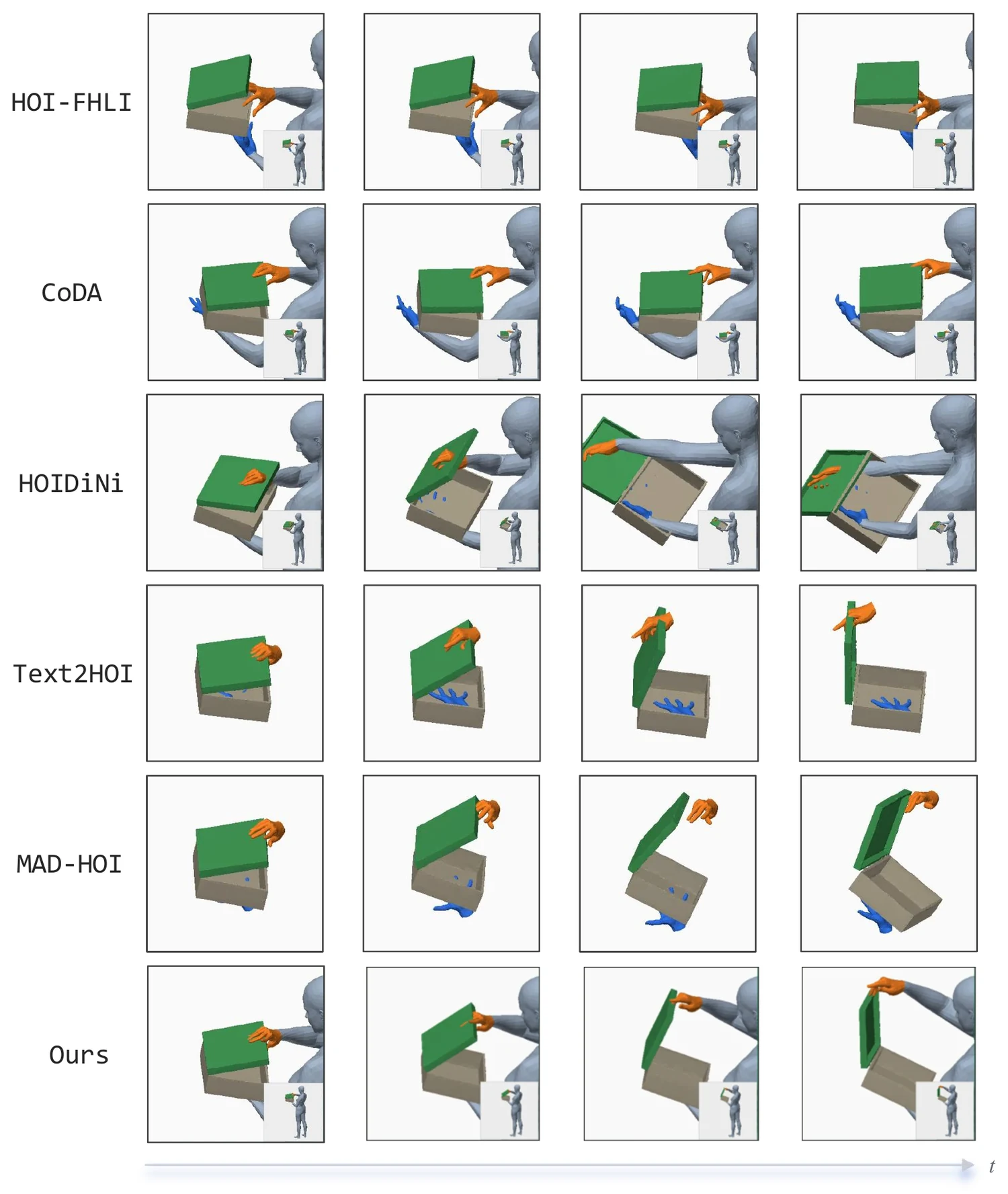
Qualitative comparison on ARCTIC. Text2HOI and MAD-HOI generate only hands and object; for the other methods, insets show the full body.
Robot Simulation
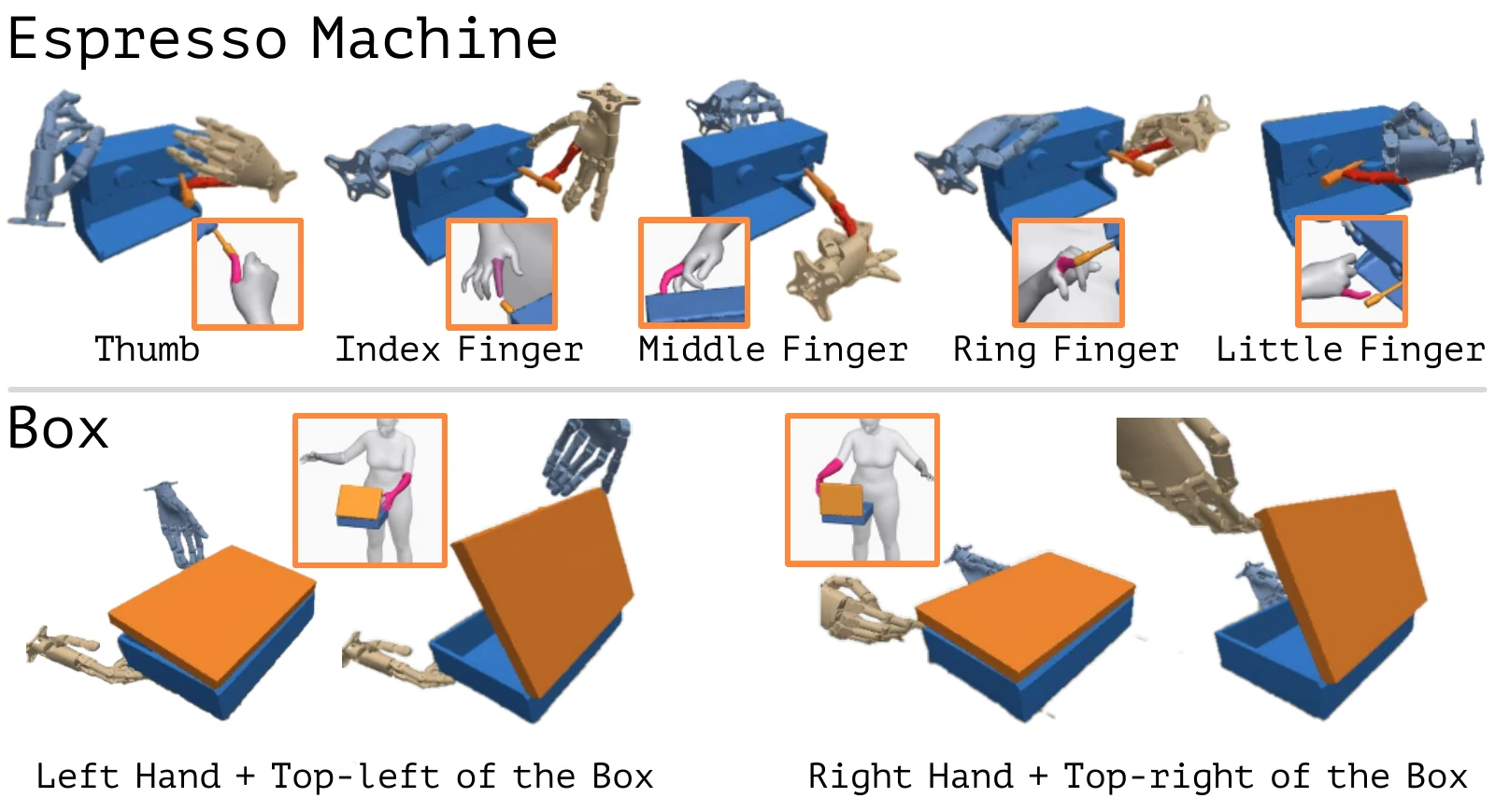
Fine-grained control in simulation. Top: finger-specific manipulation with different instructed fingers. Bottom: hand selection and designated contact on an articulated object.
Practice turns priors into success
Task success (%) ↑ on articulated-object tasks under randomized dynamics.
Method
Floating Wuji hands
Unitree G1 + Wuji hands
Direct replay
6.2
13.3
FineDex w/o practice
19.5
11.7
Search planner + priors
48.4
39.1
Astra w/o priors or library
59.4
28.9
Astra w/o priors
68.8
35.2
FineDex (GPT-6 Astra)
75.0
42.2
FineDex (Claude Fable 5.2)
77.3
46.9
Practice budget
Up to 4 rounds
75.0Floating Wuji hands
42.2Unitree G1 + Wuji hands
Hover the chart or use ← → to step.
Object configuration generalization
Task success (%) ↑ under changes in placement, size, and initial articulation of objects.
w/o HOI priorsFineDex
Gain ↑
Real world
On a real humanoid
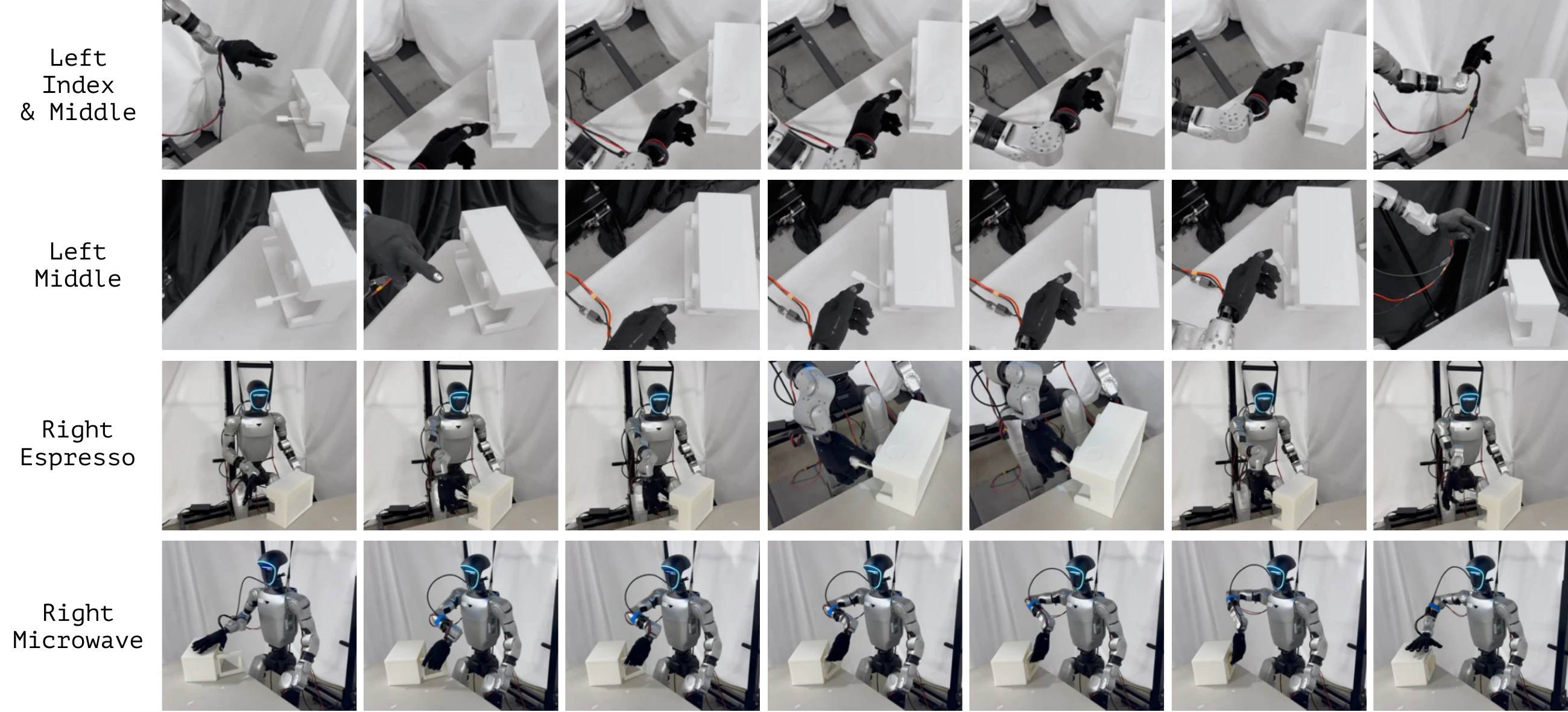
On a real Unitree G1 humanoid with Wuji 2.2 hands, FineDex completes articulated-object tasks under constraints it was never trained for, such as operating with the left hand only or with a single designated finger.
All videos play at 1× speed.
left hand · index + middle fingers · espresso machine
left hand · index + middle · close-up
right hand · espresso machine
Swipe sideways to see the whole figure →
Real-world dexterous manipulation. G1 humanoid manipulation with different hand and finger instructions across articulated objects.
BibTeX
@misc{zeng2026finedexbridgingfinegrainedhumanobject,
  title={FineDex: Bridging Fine-Grained Human-Object Interaction Generation to Dexterous Humanoid Manipulation},
  author={Yujia Zeng and Yuxin Chen and Yuzhen Song and Runhan Huang and Chensheng Peng and Yiyang Shao and Koushil Sreenath and Masayoshi Tomizuka and Yilun Du},
  year={2026},
  eprint={2611.34884},
  archivePrefix={arXiv},
  primaryClass={cs.RO},
  url={https://arxiv.org/abs/2611.34884},
}